
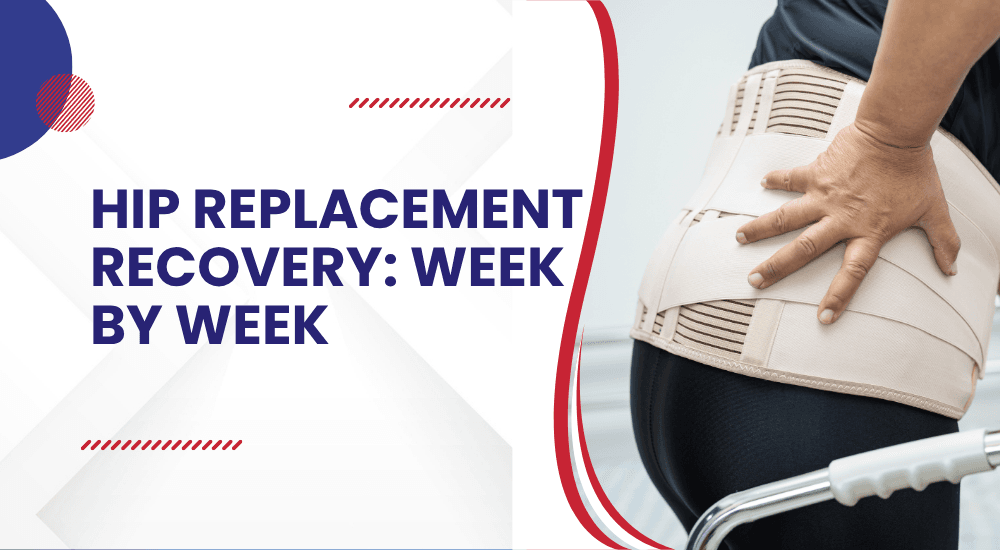
Hip replacement recovery follows a fairly set rhythm, running from supported walking in the first week to comfortable, near-normal movement by roughly the three-month mark. Most people are up on a frame or crutches within a day, then onto a single stick over the weeks that follow. The early stretch is mostly about protecting the new joint and coaxing it to move; the back half leans on rebuilding strength and stamina. How quickly it all goes comes down to your age, your fitness beforehand, and how seriously you take the rehab.
According to Dr. Venkata Swamy Boorgula, best orthopedic hospital in Kompally, “the people who recover fastest are usually the ones who move early and don’t panic at a bit of discomfort, because a hip that’s used sensibly settles far quicker than one that’s babied.”
Wondering how soon you’ll walk unaided after a hip replacement?
What happens in the first few weeks after hip replacement?
The opening weeks set the tone, and they’re more active than most people expect going in.
Week 1
Starts on your feet, usually within a day, taking short supported walks with a frame or crutches while the team keeps a close eye on pain and swelling
Weeks 2 to 3
Bring steadier walking, less leaning on the aids, and the small daily wins like managing the stairs or rising from a chair without help
Swelling
Around the hip and thigh is normal through this stretch, and it eases with elevation, ice, and the gentle movement that keeps the blood shifting
Precautions
Matter early, so most surgeons ask you to skip crossing the legs, bending the hip too far, or twisting on the new joint for the first several weeks
Sticking to the plan your orthopedic team lays out now is what keeps the recovery boringly on track, which is exactly what you want from it.
How long until a hip replacement feels fully recovered?
The big milestones land over months rather than weeks, and the finish line sits further out than the early progress suggests.
Weeks 4 to 6
Usually when the walking stick gets retired and ordinary days, the light shopping, the cooking, the short outings, start feeling manageable again
6 to 12 Weeks
Strength-building window, where physio steps up and the muscles around the joint start carrying their proper share of the load
Driving
Tends to return somewhere near the six-week mark, once you can brake and react without hesitation, though your surgeon makes the final call on it
Full recovery
the point where the hip just feels like yours again, often takes three to six months, and a little longer before anything high-impact
If a worn hip is what pushed you toward surgery, the other big joint often follows the same script, which is why the signs a knee replacement is due are worth knowing too.
Why Choose Roma Hospital?
Dr. Venkata Swamy Boorgula holds MBBS, MRCS (UK) and FRCS (London), with over 25 years in joint replacement, arthroscopy and complex trauma, much of it spent in London before he moved the practice back to India. Hip and knee replacement, including the tricky revision cases, has been core to that work for decades, so the recovery roadmap he hands patients is built on a lot of hips that have walked out well.
What patients get is a recovery plan paced to their own hip rather than a generic checklist, plus a team that flags problems early instead of waiting for the follow-up to find them. The point is a joint they stop thinking about, one that walks, bends, and sits without a second thought, reached on a sensible timeline.
Call +91 62093 33999 to book your consultation or for emergencies.
FAQ's
How soon can I walk after hip replacement?
Most people take supported steps within a day of surgery.
How long does a hip replacement last?
Modern implants commonly last fifteen to twenty years or more with normal use.
When can I sleep on my side again?
Often after six weeks, once the surgeon confirms the joint is stable.
Will I set off airport metal detectors?
Some implants can, so carry a note from your surgeon if needed.
References
- National Library of Medicine, StatPearls: Total Hip Arthroplasty Techniques — https://www.ncbi.nlm.nih.gov/books/NBK507864/
- National Institutes of Health, PMC: Rehabilitation regimes after total hip replacement — https://www.ncbi.nlm.nih.gov/pmc/articles/PMC3292973/