
Perimenopause is the transition phase before menopause, and for most women, it begins between the ages of 40 and 47. Periods become irregular, sleep gets disrupted, mood swings show up out of nowhere, and the body starts behaving in ways that feel unfamiliar. The hormonal shift is real, but it’s also treatable, and most symptoms can be managed well with the right combination of lifestyle changes, medical support, and regular monitoring.
This phase typically lasts 4 to 8 years before periods stop completely. The challenge is that most women in their 40s dismiss the early signs as stress, work pressure, or just “getting older,” and end up suffering quietly for years before getting help.
At Roma Hospital, the gynecology team led by Dr. Pulla Anusha has guided many women in Kompally and across north Hyderabad through this exact transition, with care that treats both the symptoms and the long-term health risks that come with hormonal change.
The Science Behind Perimenopause
During perimenopause, the ovaries gradually slow their production of estrogen and progesterone, the two main hormones that regulate the menstrual cycle. The decline isn’t smooth or steady. Hormone levels can swing dramatically from one month to the next, which is why symptoms feel inconsistent and unpredictable.
The transition is divided into two phases:
- Early perimenopause: periods are still mostly regular but cycle length starts varying by 7 days or more. Sleep, mood, and energy may already feel different.
- Late perimenopause: gaps between periods stretch to 60 days or longer. Hot flashes intensify, vaginal dryness becomes common, and bone density starts dropping.
Once a woman has gone 12 consecutive months without a period, she’s officially in menopause and perimenopause is over. The average age of menopause in Indian women is 46 to 47, slightly earlier than the global average.
Tracking these changes early and getting evaluated by a specialist in women’s health makes treatment far more effective than waiting until symptoms become disruptive.
Early Signs Women Often Brush Aside
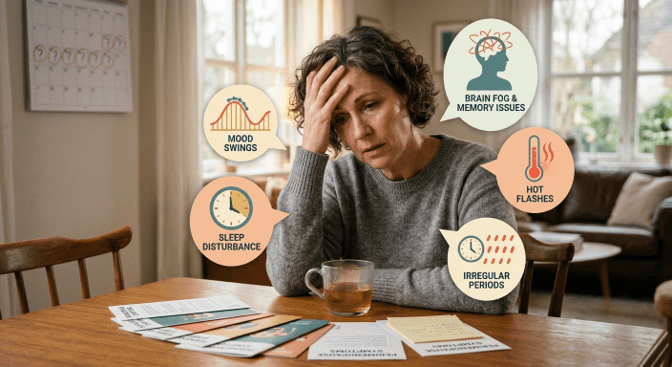
Perimenopause shows up differently from one woman to the next, which is part of why it gets missed. The signs often get blamed on stress, work, or family pressures for years. Worth flagging to a doctor if you notice:
- Irregular periods: cycle length changes by more than 7 days, periods are heavier or lighter than usual, or you skip months entirely.
- Hot flashes and night sweats: sudden waves of heat, often followed by sweating and chills. Night sweats can wake you up multiple times a week.
- Sleep disruption: difficulty falling asleep, waking up at 3 or 4 AM, or feeling unrested despite full hours in bed.
- Mood changes: new anxiety, irritability, or low mood that feels different from your usual emotional pattern.
- Vaginal dryness: dryness, itching, or discomfort during intercourse.
- Weight changes: weight gain especially around the abdomen, even when eating and exercising the same as before.
- Brain fog: trouble concentrating, forgetting words, or feeling mentally “slower”.
- Joint aches: new stiffness or pain in joints that wasn’t there before.
Any one of these alone may mean little. Several together is a reason to get checked.
Noticing several of these symptoms after years of brushing them off? A consultation can give you answers instead of another year of uncertainty.
Red Flags You Shouldn't Ignore
Most perimenopause symptoms are uncomfortable but not dangerous. However, some signs need urgent medical evaluation because they can point to conditions other than perimenopause:
- Very heavy bleeding: soaking through a pad or tampon every hour for 2 or more hours, or passing large blood clots.
- Bleeding between periods: spotting or bleeding outside your normal cycle.
- Periods that come too frequently: cycles shorter than 21 days.
- Bleeding after intercourse: any bleeding triggered by sex, regardless of how light.
- Severe pelvic pain: pain that wakes you up at night or disrupts daily activities.
- Bleeding after a year of no periods: any bleeding after you’ve reached menopause is never normal.
Any of these need a prompt consultation. They can be caused by fibroids, polyps, hormonal imbalances, or in rare cases, conditions that need immediate attention. Roma Hospital’s gynecology team handles urgent gynec concerns with same-week appointments and in-house ultrasound, so diagnosis and treatment planning happen in a single visit.
How Perimenopause Shows Up Differently
| Profile | Typical Picture | Main Focus of Care |
| Early 40s, healthy | Subtle cycle changes, mood shifts, energy dips, sleep disruption | Lifestyle support, sleep hygiene, stress management |
| Late 40s, classic symptoms | Hot flashes, irregular periods, vaginal dryness, weight gain | Symptom-targeted treatment, hormonal evaluation |
| With diabetes or BP | Symptoms harder to manage, faster bone loss, higher heart risk | Coordinated gynec and general medicine care |
| Family history of early menopause | Symptoms may start in late 30s, faster progression | Earlier evaluation, bone density baseline |
Women managing diabetes, blood pressure, or thyroid concerns during this transition often benefit from coordinated care with an experienced internal medicine consultant, since perimenopause raises the risk of cardiovascular and bone-related complications.
Treatment Strategies That Actually Work

There’s no single cure for perimenopause because it’s a natural phase, not an illness. But it is very manageable. Treatment is built around your specific symptoms, goals, and overall health profile.
Main approaches include:
- Lifestyle changes: the foundation for everyone. Regular exercise, calcium and vitamin D-rich diet, stress reduction, and good sleep hygiene improve most symptoms within 2 to 3 months.
- Hormone therapy: for severe hot flashes, mood symptoms, or vaginal dryness, low-dose hormone therapy can offer significant relief. Used carefully, monitored regularly, and only when appropriate for the patient.
- Non-hormonal medication: certain medications can help with hot flashes, mood symptoms, and sleep issues without using hormones, useful for women who can’t take hormone therapy.
- Vaginal treatments: local estrogen creams or moisturisers for vaginal dryness and discomfort, with very low systemic absorption.
- Bone health support: calcium, vitamin D, and weight-bearing exercise to protect against the rapid bone loss that starts in late perimenopause. Women with existing joint concerns may also benefit from an orthopedic assessment to track bone and joint health.
- Regular monitoring: annual reviews to track blood pressure, cholesterol, blood sugar, thyroid, and bone density as you move through the transition.
Treatment plans are built around what each woman is actually experiencing. Two women in the same age group can have completely different symptom profiles, and treatment should reflect that.
Living with perimenopause symptoms and want a clear plan that fits your life? Take the first step toward proper care today.
Why Choose Roma Hospital for Perimenopause Care
Perimenopause touches hormones, metabolism, bone health, mental health, and reproductive health all at once. It needs a team that treats the whole picture, not just one symptom at a time.
Built to international standards, Roma Hospital is a multispeciality hospital in Kompally that brings that range together:

- Experienced gynecology specialist: Department led by Dr. Pulla Anusha, MBBS, MS (Gynaecology & Obstetrics), with deep clinical experience across menstrual disorders, hormonal care, and women’s mid-life health.
- Whole-body approach: cycle, hormones, bone health, weight, and emotional wellbeing assessed together, because in perimenopause they are connected.
- In-house diagnostics: ultrasound, hormone testing, thyroid panel, lipid profile, and bone density support, available on the same premises.
- Private consultation environment: discreet rooms and patient-first communication, so women feel comfortable discussing every concern.
- Coordinated care: gynec, general medicine, and orthopedic teams work together at a 24×7 multispeciality hospital, so women managing multiple health concerns get one continuous care plan instead of running between clinics.
- Plans built around you: treatment tailored to your symptom profile, age, lifestyle, and family medical history.
FAQ's
Is perimenopause the same as menopause?
No. Perimenopause is the transition phase before menopause, when hormone levels start fluctuating and periods become irregular. Menopause is officially confirmed only after 12 consecutive months without a period.
At what age does perimenopause usually start?
Most women enter perimenopause between 40 and 47. Some may experience symptoms in their late 30s, especially if there’s a family history of early menopause.
How long does perimenopause last?
Typically 4 to 8 years before periods stop completely. Some women experience symptoms for as little as 2 years, others for over a decade.
Can I still get pregnant during perimenopause?
Yes. As long as you’re having periods, even irregular ones, pregnancy is still possible. Contraception is recommended until you’ve gone 12 months without a period.
Are hot flashes dangerous?
Hot flashes themselves are uncomfortable but not dangerous. However, frequent or severe hot flashes can disrupt sleep and quality of life, and they’re worth treating rather than enduring.