
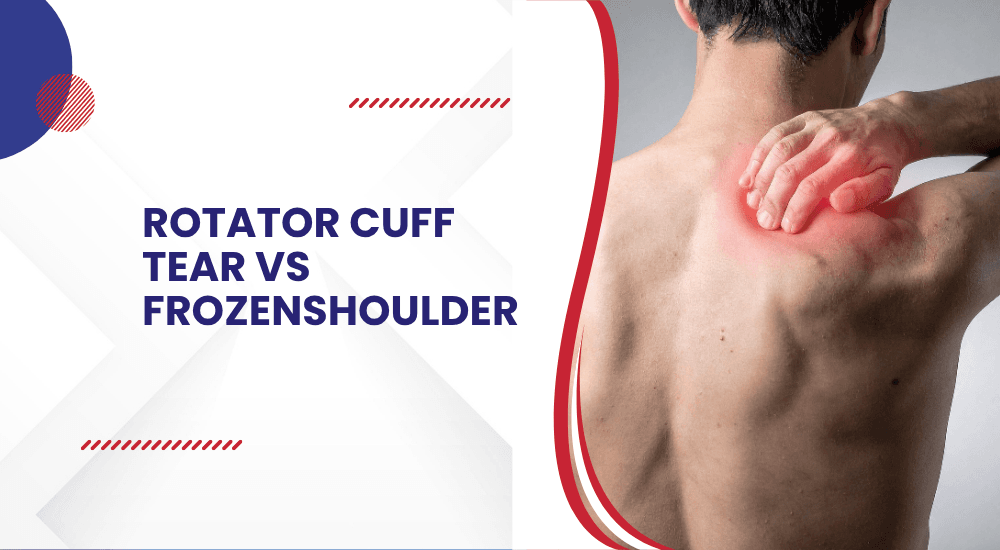
A rotator cuff tear and a frozen shoulder both cause shoulder pain, but the giveaway is weakness versus stiffness. A torn cuff leaves the shoulder weak and sore when you lift or rotate the arm, though someone else can usually still move it for you. A frozen shoulder stiffens the joint so thoroughly that neither you nor anyone else can move it far, and it tends to build in slow phases over months. Getting the two mixed up matters, because the treatment paths pull in opposite directions.
According to Dr. Venkata Swamy Boorgula, best orthopedic hospital in Kompally, “the quickest test is whether someone else can move your arm while you relax, because a torn cuff usually lets them, whereas a frozen shoulder simply won’t budge.”
Rotator cuff tear | Frozen shoulder |
Weakness lifting arm | Stiffness all directions |
Often after injury | Often no clear cause |
Others can move it | Movement blocked either way |
Linked to age, overuse | Linked to diabetes |
Not sure if your shoulder is torn or just frozen?
How do you tell a rotator cuff tear from a frozen shoulder?
A few differences separate them clearly, once you know what to look for.
Weakness or stiffness
is the big one, since a cuff tear saps your strength to lift, while a frozen shoulder locks the joint so it barely moves in any direction.
Passive movement
tells a lot, because a torn cuff usually lets someone else rotate your arm, whereas a frozen shoulder resists even that.
Onset
with tears often following a fall, a heavy lift, or years of wear, while a frozen shoulder creeps in gradually for no obvious reason.
Who it hits
offers a clue, frozen shoulder being far more common in people with diabetes or after a spell of keeping the arm still.
Because the two overlap on pain, a proper shoulder exam, sometimes with a scan, is what tells them apart with any certainty.
How does treatment differ for each?
The overlap ends at treatment, because what helps one can be wrong for the other.
A frozen shoulder
mostly wants movement, with physiotherapy, stretching, and sometimes an injection to break the stiffness cycle, and it often settles on its own given time.
A cuff tear
leans the other way, where a torn tendon may need protecting first and, for bigger tears, surgical repair rather than pushing through the pain.
Rushing a frozen shoulder
with aggressive force can flare it up, so the pace of rehab matters every bit as much as the exercises.
Ignoring a cuff tear
only lets it widen, so the early, accurate label is what keeps the shoulder from quietly getting worse.
Shoulders aren’t the only joint where a quiet tear gets brushed off, and the rotator cuff in the shoulder falls into much the same trap.
Why Choose Roma Hospital?
Dr. Venkata Swamy Boorgula holds MBBS, MRCS (UK) and FRCS (London), with over 25 years across arthroscopy, joint replacement and complex trauma, much of it built up in London before he moved the practice back to India. Telling a stiff shoulder from a torn one, and treating each the right way, is exactly the sort of everyday call his shoulder work turns on.
What patients get is the correct diagnosis first, backed by in-house imaging when the picture’s unclear, so nobody ends up stretching a tear or resting a shoulder that needed moving. From there the plan matches the actual problem, whether that’s guided physio, an injection, or repair.
Call +91 62093 33999 to book your consultation.
FAQ's
Can a rotator cuff tear cause a frozen shoulder?
Yes, keeping the arm still after a tear can sometimes trigger frozen shoulders.
Does a frozen shoulder go away on its own?
Often yes, though it can take one to three years to fully resolve.
Which is more painful at night?
Both can disturb sleep, but night pain is especially typical of cuff tears.
How are they diagnosed?
A physical exam checks movement, with MRI or ultrasound confirming a cuff tear.
Reference:
- National Library of Medicine, StatPearls: Adhesive Capsulitis (Frozen Shoulder) — https://www.ncbi.nlm.nih.gov/books/NBK532955/
- National Library of Medicine, StatPearls: Rotator Cuff Injury — https://www.ncbi.nlm.nih.gov/books/NBK547664/