
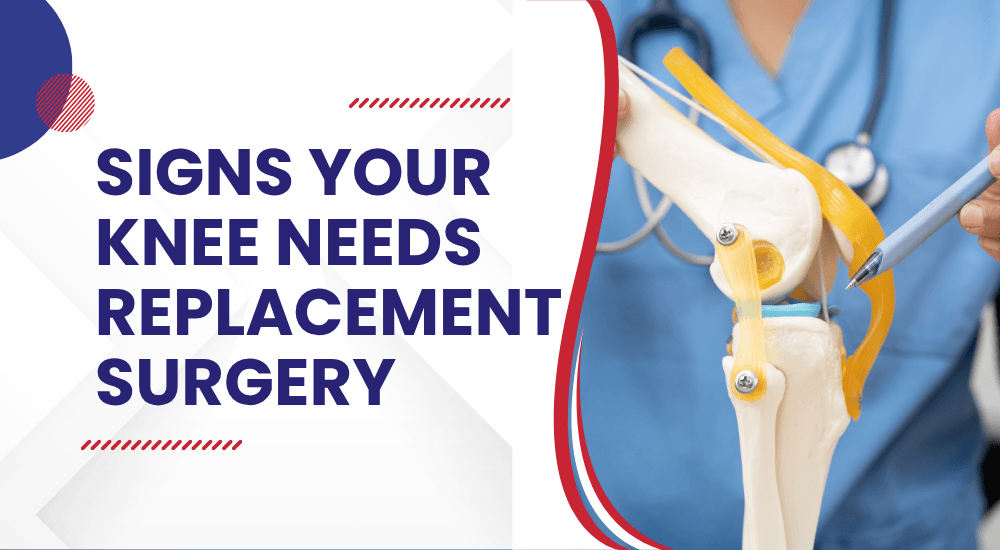
A knee usually needs replacement when cartilage damage is advanced enough that the joint. Resulting in improper function without constant pain, and non-surgical treatment no longer helps. The clearest signs include pain at rest, night pain, visible deformity, and a sharp drop in walking distance. Diagnosis is confirmed through clinical exam and weight-bearing X-rays. The final call depends on how much the knee is restricting daily life.
According to Dr. Venkata Swamy Boorgula, best orthopedic hospital in Kompally, “Patients often wait too long. By the time they come in, the joint has been compensating for years and the surrounding muscles are already weak. Earlier review gives better outcomes.”
Is the knee pain stopping you from sleeping or walking normally?
Which Symptoms Mean the Knee Has Crossed the Surgical Line?
Most knees can be managed without surgery for years. A specific set of signs usually means that window has closed.
Rest pain
When the knee hurts while you’re sitting, standing still, or lying in bed, the joint is no longer just inflamed. The cartilage is gone in the load-bearing area.
Night discomfort
Pain that wakes you up, or stops you falling asleep, is one of the strongest indicators that conservative treatment has stopped working.
Visible bend
Bow legs or knock knees that have appeared over the last few years mean the joint is collapsing on one side. Bracing won’t reverse it.
Walking drop
If you used to manage a kilometre and now you’re stopping at the gate, the knee has lost the structural reserve it needs to support normal mobility.
Patients showing three or more of these signs together are usually ready for joint replacement.
What Should You Do Before Opting for Surgery?
A few non-surgical steps still matter, even when surgery seems likely. They sharpen the diagnosis and improve the outcome.
Imaging
A standing X-ray of both knees, not a lying-down one. The cartilage gap only shows properly under body weight.
Trial
A structured course of physiotherapy and one round of intra-articular injections gives a clear answer on whether the knee will respond. If it doesn’t, that’s data.
Weight check
Even a 4–5 kg reduction before surgery makes recovery noticeably smoother. Worth doing.
Pre-op fitness
Sugar control, blood pressure, cardiac clearance. These get sorted before the date is fixed, not after.
Patients often ask how long recovery actually takes once the decision is made, which we covered in our piece on knee surgery.
Why Choose Roma Hospital?
Roma Hospital runs a dedicated joint replacement setup in Kompally, with modular operation theatres, an in-house physiotherapy unit, and orthopedic surgeons who handle knee and hip replacements as a regular part of their week rather than an occasional procedure. The imaging, the surgery, and the post-op rehab all sit under one roof, so a patient isn’t shuttling between centres mid-treatment.
What tends to matter more to patients is the recovery side, and that’s where the structured rehab protocol does the heavy lifting, getting most people standing within a day of surgery and walking short distances by the time they go home. Knee replacement here is judged by the six-month mark, whether the patient is back on stairs without bracing the rail and sleeping through the night.
Call +91 62093 33999 to book your consultation.
FAQ's
Can knee replacement be avoided once symptoms become severe?
In most advanced cases, surgery is the only treatment that restores function reliably.
How long does a knee implant last?
Modern implants last 20 to 25 years in patients who avoid heavy impact loading.
Is the surgery painful afterwards?
Pain is significant for the first week, then drops sharply with proper rehab.
Can I drive after a knee replacement?
Most patients return to driving between six and eight weeks after the operation.