
At 6 months after ACL reconstruction, rehab shifts from rebuilding basic strength to preparing the knee for high-load, high-speed, sport-specific movement. Most patients at this stage should be doing single-leg strength work, controlled jumping and landing drills, agility patterns like cutting and pivoting, and sport-specific skills, all under structured progression. The graft is biologically strongest from month 6 onward, but full return to competitive sport usually requires another 3 to 6 months of focused work.
This is also the stage where rehab progress matters most. Many athletes feel ready to play again because the knee feels good day to day. But strength deficits, balance issues, and movement patterns that haven’t been corrected at month 6 are the leading cause of re-injury once they return to sport.
At Roma Hospital, the orthopedic team led by Dr. Venkata Swamy Boorgula, with 25+ years of consultant experience in joint replacement and sports surgery in London, UK, guides ACL patients through structured return-to-sport protocols built around each athlete’s sport, level, and goals.
Why the 6-Month Mark Is a Critical Stage
ACL reconstruction uses a graft (most commonly from your own hamstring or patellar tendon) to replace the torn ligament. The graft doesn’t function as a true ligament from day one. It goes through a long healing process called ligamentization.
The biology breaks down roughly like this:
Months 0 to 3:
graft is at its weakest, as the body breaks down the old tissue and starts laying down new collagen fibres.
Months 3 to 6:
new tissue forms, but it’s still organising. Graft strength gradually returns.
Months 6 to 12:
graft is biologically strong enough to handle high loads. This is when sport-specific training intensifies.
Beyond 12 months:
the graft continues to mature and remodel for up to 2 years.
Month 6 is the green light for harder training, but it’s not the green light for full sport. The graft can handle load now, but the muscles around the knee, the balance system, and movement patterns still need work.
Women athletes face an added consideration during ACL recovery. Female ACL injury rates are 2 to 8 times higher than men’s in pivoting sports, partly due to hormonal and biomechanical differences. Athletes who have hormonal concerns or irregular cycles benefit from a parallel review with a specialist in women’s health, since hormonal balance plays a real role in tissue healing and re-injury risk.
Strength Exercises You Should Be Doing
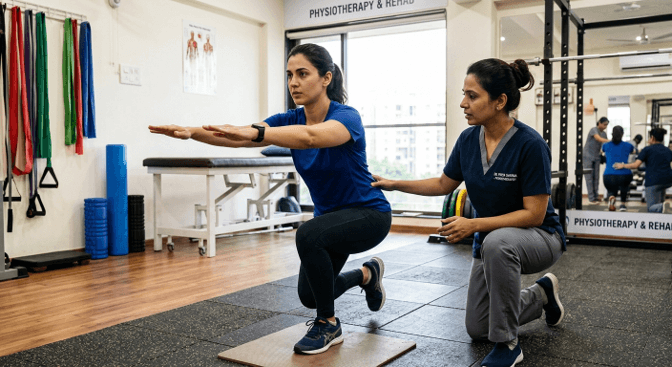
At 6 months, strength work focuses on closing the gap between the operated leg and the uninjured leg. Most patients still have a 15 to 25 percent strength deficit in the surgical knee at this stage. Closing that gap is the priority before any return-to-sport clearance.
Core strength exercises at this stage:
Single-leg squats:
the gold-standard exercise for ACL recovery. Aim for controlled, full-range movement with no knee collapse.
Bulgarian split squats:
builds quad and glute strength while challenging balance.
Romanian deadlifts (single-leg):
critical for hamstring strength, especially important if your graft came from the hamstring.
Step-ups and step-downs:
controlled stepping onto and off a box, building eccentric strength.
Lateral lunges:
trains side-to-side movement, often weak after ACL surgery.
Heavy resistance training:
leg press, hamstring curls, and quad extensions with progressively heavier loads.
All strength work should be done both legs, with the surgical leg always matching or exceeding the volume done on the healthy leg. Symmetry is the goal.
If you’re not sure whether your rehab progression matches what’s expected at this stage, Roma Hospital’s joint and sports surgery specialists review recovery progress with structured strength testing before clearing patients to advance.
Not sure if your 6-month rehab is on track? A structured assessment can highlight strength gaps before they cause a setback.
Agility and Plyometric Drills to Add
Once basic strength is rebuilding well, the next layer is teaching the knee to absorb load at speed and change direction safely. This is where most return-to-sport rehab plans fall short, and where the highest risk of re-injury sits.
Plyometric and agility drills to introduce around month 6:
Double-leg jumps:
box jumps, broad jumps, and vertical jumps with controlled landings.
Single-leg jumps:
hopping forward, sideways, and diagonally on the surgical leg.
Drop landings:
stepping off a low box and landing softly with bent knees, training the body to absorb impact.
Lateral bounding:
jumping side to side and sticking the landing on one leg.
Cutting drills:
controlled change-of-direction work, first at low speed and progressing to game-speed.
Sport-specific patterns:
mimicking the movements of your sport, whether that’s football cutting, basketball pivoting, or badminton lunges.
Every plyometric and agility drill needs to start at controlled speed and progress gradually. Jumping in to full-speed sport movements at month 6 without this build-up is the most common cause of graft re-tear.
Return-to-Sport Testing: Are You Actually Ready?
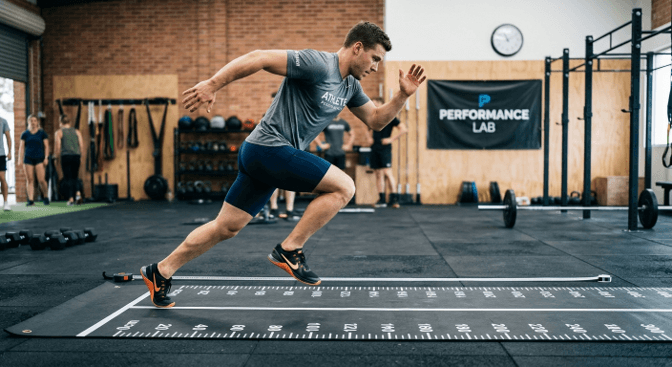
Feeling ready isn’t the same as being ready. Most surgeons and physiotherapists use a battery of return-to-sport tests to objectively measure if the knee can handle competitive load. Common benchmarks include:
Single-leg hop tests:
single hop for distance, triple hop, crossover hop. Surgical leg should reach 90% or more of the uninjured leg’s distance.
Quadriceps strength index:
peak quad strength on the surgical side should be at least 90% of the healthy side.
Y-balance test:
measures balance and reach symmetry in three directions.
Drop landing quality:
landing form is graded for knee alignment, no inward collapse, and symmetric weight distribution.
Sport-specific testing:
controlled simulations of game scenarios with a physio observing.
Patients who pass these tests at 6 months are usually cleared to begin gradual return-to-training, but typically not full competitive play until month 9 to 12. Skipping testing and returning early is associated with up to a 7-fold higher risk of re-tear.
How Recovery Differs Across Different Athletes
ACL recovery looks different depending on your sport, age, and pre-injury fitness. Here’s a snapshot of how the typical 6-month picture unfolds across patient profiles:
| Athlete Profile | Typical Picture at Month 6 | Main Focus of Rehab |
| Competitive athlete (under 25) | Strong strength recovery, often pushing too hard too soon | Patience, sport-specific testing, controlled return |
| Recreational athlete (25 to 40) | Good day-to-day function, still some strength deficits | Strength symmetry, gradual sport reintroduction |
| Older patient (40+) | Slower strength recovery, focus on daily function over sport | Joint protection, low-impact strength, walking and cycling |
| Patient with diabetes or metabolic issues | Slower tissue healing, possible delays in milestones | Coordinated care with general medicine team |
Patients managing chronic conditions during recovery often benefit from coordinated care with an experienced internal medicine consultant, since uncontrolled diabetes or blood pressure can slow tissue healing and delay rehab milestones.
Warning Signs That Mean You Should Slow Down
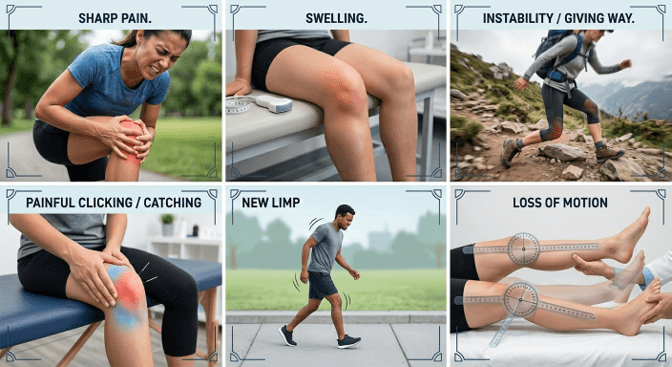
Most aches and tightness at 6 months are part of training adaptation. But some symptoms shouldn’t be pushed through:
Sharp, sudden pain in the knee during or after exercise
Visible swelling after training that takes more than 24 hours to settle
Knee giving way or feeling unstable during normal activity
Clicking or catching that’s painful (not just noisy)
Pain in the groin or buttock that wasn’t there at month 2 or 3
New limp that wasn’t there a few weeks ago
Loss of full range of motion you’d previously regained
Any of these need a prompt review. The orthopedic team at Roma Hospital handles ACL recovery concerns with same-week appointments and in-house imaging when needed.
Knee feeling unstable, swollen, or painful during rehab? Don’t push through it. Get assessed before it sets your recovery back.
Why Choose Roma Hospital for ACL Rehabilitation
ACL recovery is more than just the surgery. It needs a team that follows you through the full year of healing and return-to-sport, not just until discharge.
Built to international standards, Roma Hospital is a multispeciality hospital in Kompally that brings that range together:
- London-trained surgical leadership: Department led by Dr. Venkata Swamy Boorgula, MBBS, MRCS, FRCS, with 25+ years of consultant experience in orthopaedic trauma and sports surgery in London, UK.
- Structured return-to-sport protocols: Recovery plans built around each athlete’s sport, level, and timeline, with measurable milestones.
- In-house diagnostics and imaging: MRI access for recovery concerns without sending patients across the city.
- On-site rehabilitation centre: a dedicated rehab centre on the first floor for post-ACL strength training, supervised exercise, and progress reviews, all in the same building as your surgical follow-up.
- Coordinated care: orthopedic, general medicine, and physiotherapy teams work together round the clock, so athletes managing other health issues get one continuous care plan.
- Long-term follow-up: checks at 6, 9, and 12 months to ensure safe return to competitive play.
- Patient-first communication: every milestone, restriction, and clearance explained in plain language.
FAQ's
Can I run at 6 months after ACL surgery?
Most patients can start light jogging on a treadmill or flat ground around month 5 to 6, provided strength tests show good symmetry. Sprinting and outdoor running on uneven surfaces usually wait until month 7 or 8.
How long until I can play competitive sport again?
Most patients return to non-contact training around month 6 to 9, and competitive play around month 9 to 12. Athletes who skip return-to-sport testing and return earlier have significantly higher re-injury rates.
Why does my knee still feel tight 6 months after ACL surgery?
Some tightness is normal at 6 months. The scar tissue around the graft is still maturing, and the joint capsule continues to soften over the next 6 months. Persistent stiffness that affects function should be reviewed by your surgical team.
Should I wear a knee brace during sport at this stage?
Some tightness is normal at 6 months. The scar tissue around the graft is still maturing, and the joint capsule continues to soften over the next 6 months. Persistent stiffness that affects function should be reviewed by your surgical team.
Should I wear a knee brace during sport at this stage?
Brace use depends on the type of sport, surgeon preference, and individual progress. Some surgeons recommend functional braces for cutting sports for the first 6 to 12 months after return-to-play. Discuss this with your orthopedic team.
What's the risk of tearing the ACL again?
The re-tear rate for the operated knee is around 5 to 7 percent, and the risk of tearing the other knee’s ACL is similar. Both risks drop sharply with structured rehab, return-to-sport testing, and careful progression.